
Top Science, STEM & Astronomy Products at Quarky Science (Victoria, BC)
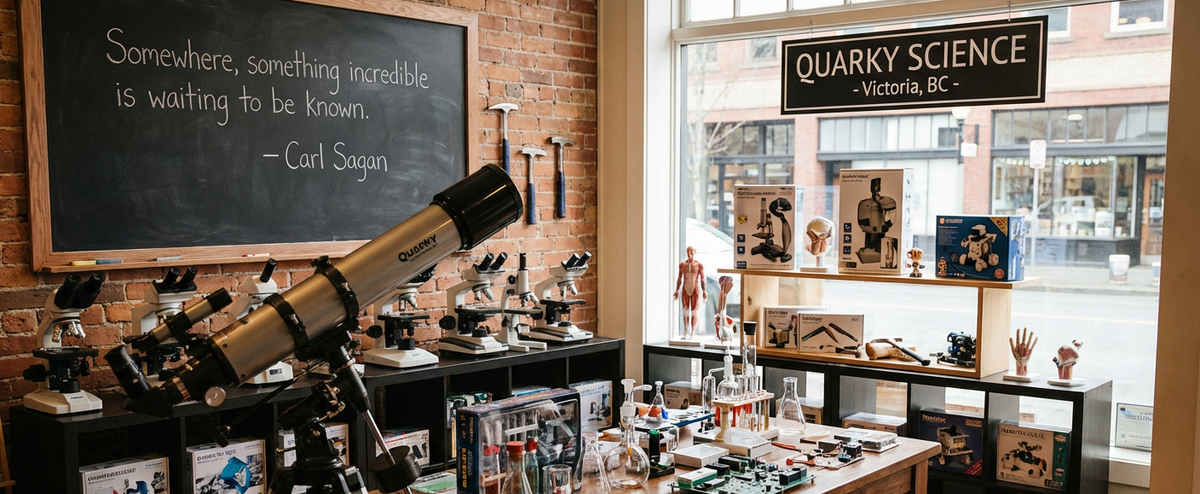
Quarky Science positioned itself as a specialty retailer for people who take science seriously – from classroom experiments to advanced amateur astronomy. Below are the key products that best reflect the store’s focus and expertise.
“Somewhere, something incredible is waiting to be known.” – Carl Sagan
What Quarky Science Sold: Core Product Categories and Who They Served
”Canada ranks among the top countries for amateur astronomy participation per capita – with over 50 dedicated astronomy clubs from coast to coast.”
Before diving into detailed product reviews, it helps to see how Quarky Science structured its inventory. The store focused on practical science tools, serious astronomy gear, and hands-on STEM kits designed for real learning – not novelty items.
Category | Key Products | Primary Users | Core Learning Focus |
Laboratory Equipment | Watch Glass (150mm), Trapezium Glass Block | Schools, small labs, STEM programs | Chemistry fundamentals, optics, refraction |
Microscopy & Biology | Walter Slide Making Kit, M Series Binocular Microscope, Deluxe Handheld Digital Microscope | High school, university, homeschool, hobbyists | Cell biology, specimen prep, digital imaging |
Advanced Astronomy | 14” Computerized Dobsonian, 12” Collapsible Dobsonian | Amateur astronomers | Deep-sky observation, Go-To tracking |
Astronomy Accessories | Super Plössl 17mm Eyepiece, Celestron EclipSmart Solar Filter | Backyard astronomers | Optical clarity, safe solar viewing |
Electronics & Engineering | Snap Circuits Pro 500 | Middle & high school students | Circuit design, applied electronics |
Renewable Energy Education | Solar Deluxe Educational Kit | STEM classrooms, homeschool | Solar circuits, voltage & current concepts |
Geology & Earth Science | Discovery Planet Rock Tumbler | Families, youth programs | Mineral polishing, abrasion processes |
Engineering History Models | da Vinci Paddle Boat Kit, da Vinci Great Kite Kit | Ages 8+, STEM enrichment | Mechanics, invention history, design principles |
This structured mix shows that Quarky Science was not a general toy store. It operated as a focused STEM and optics retailer serving educators, amateur astronomers, homeschool families, and science enthusiasts across Greater Victoria and beyond.
With that context in mind, let’s take a closer look at the individual products that defined this lineup. Each item below reflects the store’s emphasis on practical learning, technical reliability, and hands-on exploration – whether in a classroom, a home lab, or under the night sky.
Watch Glass (Evaporating Dish), 150mm
A classic laboratory tool made of heat-resistant glass, commonly referred to as a watch glass in chemistry settings.
Common uses:
- Evaporating small volumes of liquid
- Covering beakers and flasks
- Preparing samples for microscopy
- Demonstrating basic chemical processes
The 150 mm diameter makes it practical for both school labs and home STEM use. It’s a simple yet versatile tool that shows the store dealt with real laboratory equipment — not just science toys.
Walter Microscope Slide Making Kit
A complete microscope slide making kit designed for preparing custom specimens in classroom or homeschool environments.
Includes:
- 12 plain glass slides
- 2 concave slides
- 100 coverslips
- Stains (methylene blue and eosin Y)
- Plastic dropper and test tube
- Storage box
This moves students from “observing” to “creating.” The kit allows users to:
- Prepare their own biological samples
- Study plant cells and tissues
- Learn basic microbiology techniques
Ideal for students, homeschool programs, and beginner researchers.
Sky-Watcher Computerized Dobsonian 355mm (14”)
A flagship 355mm telescope built for serious amateur astronomy.
Key specifications:
- Mirror diameter: 355 mm
- Focal length: 1600 mm
- F/4.5
- SynScan GPS computerized system
- Database of 42,900 objects
This is advanced amateur level equipment. The main advantage is the Go-To system, which automatically slews the telescope to selected objects. At the same time, it can still be moved manually without needing to re-align.
An instrument like this shows the store served not only beginners but also serious members of the astronomy community.
Fun fact: The Andromeda Galaxy – visible with the naked eye – contains roughly one trillion stars. A 14” Dobsonian can resolve individual star clusters within it.
Celestron EclipSmart Solar Filter – 200mm (8”) SCT
Designed for safe solar observation, this 8 SCT solar filter meets ISO safety standards and blocks 99.999% of visible light.
Features:
- Filters 99.999% of visible light
- Protection from IR and UV radiation
- ISO 12312-2 compliant
- Independently tested
Solar observation – including sunspots and eclipses – is only safe with certified filters. Carrying this product demonstrates a strong focus on safety and responsible astronomy, rather than simply selling gadgets.
“Permanent solar retinal damage can occur in as little as a fraction of a second of unfiltered viewing – with no pain warning beforehand.”
Trapezium Glass Block
This precision glass block is used in physics classrooms to demonstrate refraction and Snell’s Law.
Dimensions: 90 × 50 × 40 × 35 mm, with two frosted and two polished faces.
Used for:
- Demonstrating Snell’s Law
- Classroom optics experiments
- Practical physics instruction
This is a standard educational tool widely used by teachers and STEM programs.
da Vinci Paddle Boat Model Kit
The paddle boat model recreates Leonardo da Vinci’s engineering concepts in a hands-on format.
Features:
- Tool-free assembly
- Educational manual
- Explains the evolution of engineering concepts
This is more than a model – it’s a historical engineering STEM kit that connects mechanics, the history of science, and hands-on construction.
Deluxe Handheld Digital Microscope
A compact digital microscope suitable for students and hobbyists.
Key features:
- 10x–40x and 150x magnification
- Built-in 2MP digital camera (photos and short videos)
- LED illumination
- Metal stand for stable positioning
- Plug-and-play compatibility (Windows & most Mac systems)
- 2-year warranty
Ideal for examining coins, insects, rocks, circuit boards, fabrics, plants, and prepared slides. It bridges physical observation with digital imaging – especially useful in classrooms and homeschool settings across Canada.
Snap Circuits Pro 500 Student Training Program
The Snap Circuits Pro 500 kit introduces electronics through modular, snap-together components.
Includes:
- 75+ parts (FM module, transformer, analog meter, recording IC)
- Builds FM radio, digital voice recorder, AC generator, adjustable light control
- Student guide + teacher guide
- Durable storage case
- Compatible with Snap Circuits 100 & 300 series
Designed for middle and high school programs, including homeschool. This is more than a toy – it’s a scalable electronics platform that introduces circuit theory in a hands-on way.
Education stat: “Studies show students retain up to 75% more information through hands-on learning compared to passive instruction.”
Collapsible Dobsonian Reflector Telescope 305mm (12″)
This 12 inch collapsible Dobsonian reflector telescope balances portability with aperture performance.
Specifications:
- 305mm aperture
- 1500mm focal length
- F/4.9
- 8×50 finder
- 2” focuser (1.25” adapter included)
The collapsible truss design improves portability without sacrificing collimation stability. Smooth azimuth bearings and tension control make tracking objects easy – even with one finger. Free shipping or pick-up in Greater Victoria was available due to its size.
M Series Binocular Microscope
A professional-grade binocular microscope suitable for secondary school, university, and lab applications.
Highlights:
- 40X to 1000X magnification
- 4x, 10x, 40x, 100xR (oil) objectives
- LED illumination
- Mechanical stage with X–Y travel
- Abbe condenser with iris diaphragm
- Parfocal, parcentered DIN objectives
This is a serious laboratory instrument, not a beginner toy. Suitable for biology labs, advanced secondary schools, and technical programs.
Solar Deluxe Educational Kit
Among popular solar power educational kits, this model introduces students to photovoltaic systems.
Includes:
- Solar panel
- Motor accessories
- Fan and lamp modules
- Circuit components
Students learn:
- Basic electrical circuits
- Solar circuit integration
- Voltage and current adjustments
This kit aligns with STEM curriculum goals and renewable energy education – especially relevant in Canadian classrooms focused on sustainability.
Discovery Planet Rock Tumbler
Geology curiosity: “Some of the semi-precious stones in tumbling kits are older than the dinosaurs – formed hundreds of millions of years ago through volcanic or sedimentary processes.”
The Discovery rock tumbler kit remains a favourite for geology learning and hobby projects. Also commonly searched as a rock tumbler Canada product, it includes:
- 0.226 kg semi-precious stones
- 3-step grinding and polishing powders
- Refill kit option
Jewellery components included:
- 18” silver-tone chain
- Adjustable rings
- Earring wires
- Key chains
- Jump rings and glue
The rock tumbler process demonstrates mechanical abrasion while producing polished stones suitable for wearable crafts.
Super Plössl 17mm Eyepiece (1.25″)
The 17mm plossl eyepiece improves contrast and clarity for amateur telescope users.
- 17mm focal length
- 52° apparent field of view
- 4-element Plössl optical design
- Edge-blackened elements for contrast
- Generous eye relief
Designed to minimize distortion and spherical aberration. A solid entry-level performance eyepiece for Canadian backyard astronomers.
Computerized Dobsonian Reflector Telescope 355mm (14″)
For advanced observers ready for Go-To tracking.
- 355mm aperture
- 1600mm focal length
- SynScan GPS
- Database of 42,900+ objects
- Manual movement without re-alignment
This telescope combines automation with traditional Dobsonian mechanics — ideal for deep-sky viewing under darker skies outside urban BC.
Walter Microscope Slide Making Kit
Complete starter kit for preparing custom slides.
- Plain and concave slides
- 100 coverslips
- Methylene blue & eosin Y stains
- Dropper, test tube, storage case
Encourages independent experimentation and specimen preparation.
da Vinci Great Kite Model Kit
The da Vinci great kite kit recreates early flight engineering principles.
- Snap-together design
- No special tools required
- Educational manual
- Ages 8+
Blends mechanical principles with history of science.
Trapezium Glass Block
Solid optical block for refraction experiments.
- Polished and frosted faces
- Ideal for teaching Snell’s law
- Standard physics lab dimensions
A core classroom demonstration tool.
While Quarky Science is no longer operating in the same way, interest in hands-on science tools has only grown. Based on current Canadian education trends and hobbyist demand, here are five types of science tools that remain especially popular today.
Top 5 Science Tools in Demand Today
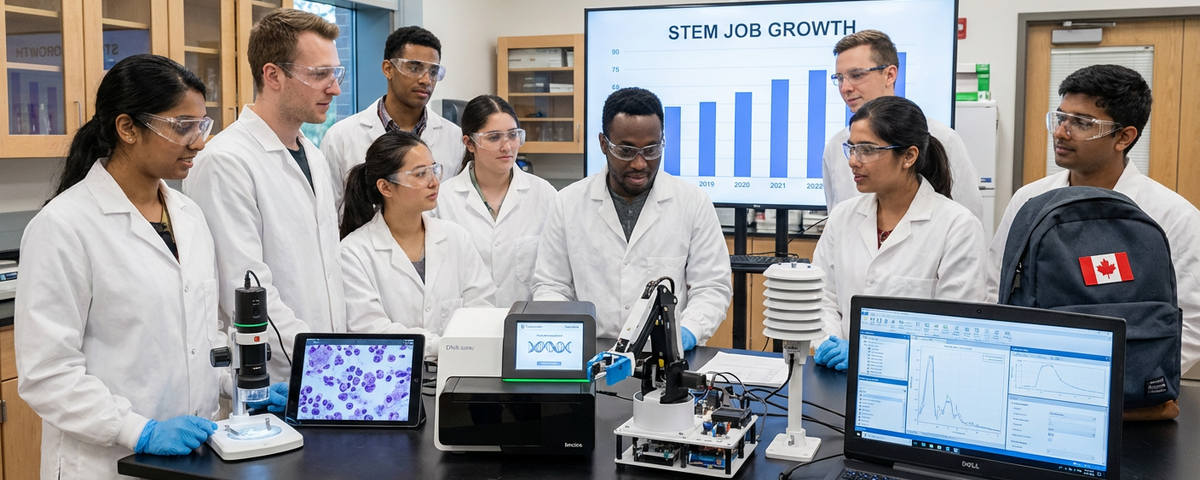
Interest in hands-on science tools continues to grow across Canada, driven by STEM education priorities, home learning, and an expanding community of hobbyists and amateur researchers. STEM job growth in Canada is projected to outpace the overall labour market by nearly 3x over the next decade – making hands-on science literacy more valuable than ever.
1. Digital Microscopes with USB or Wi-Fi Output
Digital microscopes have become standard tools in classrooms and home labs. Instead of looking through eyepieces one at a time, students can project specimens onto a laptop or large screen, capture images, and record short videos for assignments or lab reports.
Most entry- to mid-level models offer 10x–200x magnification, built-in LED lighting, and basic measurement software. USB versions are reliable and affordable, while Wi-Fi models add tablet and Chromebook compatibility. For Canadian schools and homeschool programs, the ability to document and share results is the main advantage.
2. Large-Aperture Dobsonian Telescopes (10″–14″)
Dobsonian reflectors in the 10″ to 14″ range remain popular because they deliver serious light-gathering power at a comparatively reasonable cost. With apertures this size, observers can clearly resolve globular clusters, nebulae, and galaxies under dark skies.
Manual versions appeal to purists who prefer hands-on tracking, while Go-To systems simplify object locating for beginners. The balance of aperture, portability, and price makes this category especially attractive to Canadian backyard astronomers outside major urban light pollution zones.
3. Solar Observation Filters (ISO Certified)
Interest in solar astronomy spikes around eclipses, but demand for certified solar filters remains steady year-round. Proper ISO-compliant filters block harmful infrared and ultraviolet radiation while reducing visible light to safe levels.
The key purchasing factor is certification (such as ISO 12312-2 compliance). Without it, solar viewing can permanently damage eyesight. For schools and astronomy clubs, certified filters allow safe observation of sunspots and solar activity while meeting safety standards.
4. Modular Electronics Kits (Snap-Together Systems)
Snap-based electronics kits continue to perform well in middle and secondary education. They eliminate soldering while teaching real circuit concepts such as resistance, current flow, radio transmission, and sound recording.
Advanced kits often include transformers, integrated circuits, and analog meters. The modular design allows students to scale from basic circuits to more complex builds. For Canadian STEM programs, these systems offer a practical bridge between theory and application.
5. Renewable Energy Experiment Kits
Solar and renewable energy kits reflect growing curriculum emphasis on sustainability and energy literacy. These kits typically include small photovoltaic panels, motors, wiring components, and basic load devices like fans or lamps.
Students learn how solar panels generate electricity, how voltage can be increased, and how circuits are assembled. Beyond simple demonstrations, they introduce real-world energy concepts relevant to Canada’s focus on clean technology and environmental responsibility.